
Alameda VINELink Coverage
California VINE is the statewide custody-status and notification portal used for participating California custody agencies. The research identifies the state VINE URL as California VINE. For Alameda County, VINE is best understood as a notification layer that pairs with Santa Rita Jail current custody and release changes.
CDCR's victim-services material says county jail custody status can be tracked through VINE, and that after a person transfers to CDCR, users can register with CDCR for state-prison victim services. That distinction is important. California VINE may help with a county jail custody change, while CDCR systems take over for state-prison custody and parole or release processing.
Use VINELink for one person at a time. It is not an Alameda County 24-hour release feed, not a 72-hour release archive, not a court docket, and not a federal BOP locator.
Search Alameda Inmate On VINE
A VINELink search works best before release or while the person remains visible in a participating feed. If a person has already left custody and no longer appears, move to the Alameda Inmate Locator, court records, and Sheriff's records request path rather than assuming no release occurred.
- Open California VINE and choose California.
- Search with the most specific person details available.
- Compare name, agency or facility, DOB or age if displayed, and custody status before relying on a match.
- If a current-custody result appears, note the facility or agency shown.
- If a released result appears, treat it as custody-status confirmation as of the result or notification time.
- If no result appears, check the Alameda County Inmate Locator, Alameda criminal court record, and Sheriff's records request process.
The manifest includes a matching image from the California VINE state entry. See California VINE for the live portal.
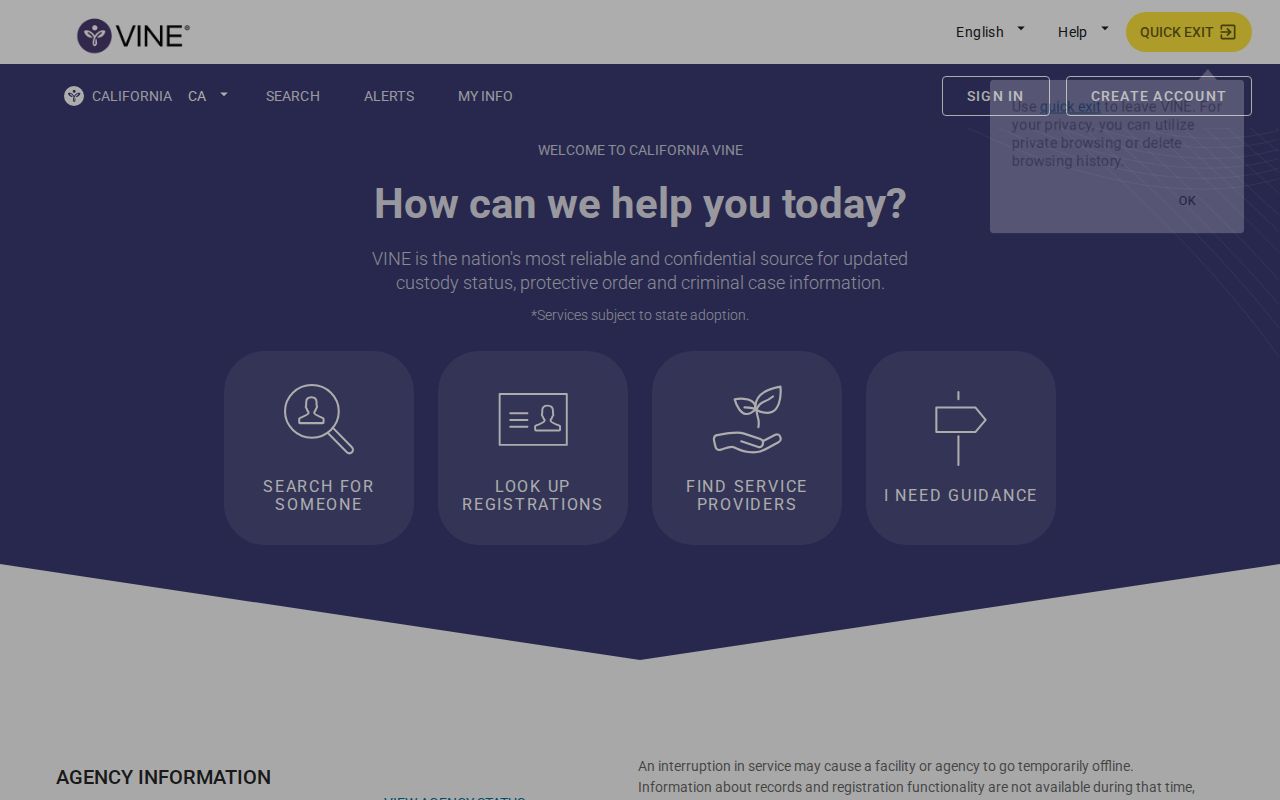
Use the live portal for current steps, because display rules and available fields can change.
VINELink Release Results
A released result in VINE should be read as custody-status confirmation, not as a full release record. It may show that the person is no longer in a participating custody status as of a notice time, but it does not necessarily provide release reason, court disposition, booking photo, or the complete release date and time fields available through a Sheriff's record.
| VINELink Item | How To Use It |
|---|---|
| Name or person match | Compare with DOB, age, facility, or agency if displayed. |
| Agency or facility | Confirms whether the result relates to Alameda custody, CDCR, or another agency. |
| Custody status | Shows current, released, transferred, or similar status when available. |
| Status date or notice time | Useful for timing, but not a replacement for the release record. |
| Notification registration | Lets a user request alerts for a custody change while the person can be found. |
Register Alameda Release Alerts
Register before release when possible. VINE is strongest as a timing tool because it can send notice when a participating agency reports a custody change. The VINELink app listing confirms in-app notification, phone, email, text where available, and TTY channels.
- Find the person's VINE record while the custody feed can still identify them.
- Select the notification or get-notified option shown by California VINE.
- Choose the available channels that fit the user's needs.
- Enter and confirm phone, email, app, or TTY details as the portal requires.
- Save or update the registration if contact information changes before release.
For phone notifications, do not assume exact PIN language unless the current California VINE screen states it. General VINE systems often use a PIN or confirmation step to stop repeated calls, but the page should follow the current California wording when exact instructions are needed.
VINELink Alameda Limits
VINELink does not provide the full court disposition, does not necessarily show release reason, is not a booking-photo source, and does not replace a Sheriff's release record when exact release date, time, or manner is needed. It also does not cover federal BOP custody; sentenced federal prisoners must be checked through BOP, while federal pretrial release or remand is a court and U.S. Marshals path.
If VINELink has no match, use Alameda's other channels. Search the Alameda County Inmate Locator for current or pending status, use Alameda Superior Court for case disposition, ask the Sheriff's Office for the booking and release record, and use CDCR CIRIS when the person was transferred to or released from state prison. ICE ODLS applies only when ICE custody actually applies.
County Jail Or CDCR
A Santa Rita Jail release and a CDCR release are different events. California VINE can help with county jail status, but CDCR's own victim-services process may be the later registration path after transfer to state prison. CDCR release processing also checks certified court documents, detainers, supervision office assignment, parole conditions, notices, and release funds.
For Alameda County, this means VINE should sit between the live jail locator and the formal records. It may alert you that custody changed. It does not say why the court ordered release, whether probation or PRCS began, or whether CDCR or another agency received the person.
No Alameda VINE Result
A no-result search in VINE should be handled carefully. It can mean the person is not in a participating feed, the name or ID does not match the feed, the person has already moved out of searchable custody status, or the custody question belongs to a different system. It does not prove that the person was never booked at Santa Rita Jail and does not prove that release occurred.
When VINE does not return a useful Alameda result, move through the local chain. Search the Alameda County Inmate Locator for current or Pending Release status. Check the criminal case portal for court disposition, sentence, warrants, and future hearings. If the person was recently released and the exact event matters, request the Sheriff's booking and release record with PFN, booking number, DOB, and case number where available.
Alameda VINE Alert Channels
The VINELink app listing confirms that alerts may be available by in-app notification, phone, email, text message, and TTY where supported. The best time to register is before the expected release, while the person can still be found in the participating custody feed. If the person is already gone from the feed, the notification function may not help with the past event.
Keep contact information current. A stale phone number or email can cause the user to miss a custody-change notice. If phone alerts use a confirmation or PIN step on the current California screen, follow that screen. The research did not authorize copying a specific California PIN workflow into the page without checking the live wording.
VINE Versus Release Record
VINE is useful because it is fast and event-focused. A Sheriff's release record is useful because it is the official local custody record. Alameda Superior Court is useful because it explains the legal result. CDCR is useful for state-prison custody and parole processing. Those systems may all describe the same person, but they do not answer the same question.
| Source | Best Use |
|---|---|
| California VINE | Custody-status alert or status check for one participating record. |
| Alameda Sheriff | Release date, time, manner, facility, and transfer notes when disclosable. |
| Alameda Superior Court | Disposition, sentence, credits, warrants, probation, and future hearings. |
| CDCR | State-prison custody, release eligibility, parole, and discharge questions. |
| BOP or ICE | Federal sentenced custody or immigration custody when those systems apply. |
Alameda VINE Timing
Timing is the main reason to use VINE. A registered alert may arrive near a custody-status change, while a Sheriff's release record may take a formal request and a court record may update on its own schedule. That makes VINE helpful for learning that something changed, especially around a Santa Rita Jail Pending Release status.
The tradeoff is detail. VINE may show release or transfer status, but it may not show the reason, the full court outcome, the exact manner of release, or whether the person moved to probation, PRCS, parole, CDCR, federal custody, or ICE. Use the alert as a prompt to verify the official record that matches the custody path.
Public Record Search
Sponsored Results